It’s a relatively simple way to confirm your Portuguese skills (although there are even easier ones). The exam is completely free, but the whole process takes quite a long time.
This post is about my experience with Encceja Ensino Fundamental, which I took in 2024. In 2025 I decided to try Ensino Médio as well (and passed!) — so I’ll probably write about that experience later too.
In 2024 registration opened around April–May, the exam itself took place on August 25, the results were published on December 23, and the final certificate became available for download after January 13.
Encceja is an exam based on the Brazilian school curriculum. It was originally designed for teenagers and adults who had to leave school early and never finished their studies. Encceja is an alternative way to obtain a school certificate.
There are two options: Ensino Fundamental — equivalent to elementary school, Ensino Médio — equivalent to high school. That time I chose Fundamental simply because it’s easier. But the registration, preparation, and certification process are the same for both.
Registration
Registration for the Encceja exam is done online. When registration opens, you need to go to this website: http://enccejanacional.inep.gov.br/encceja/#!/inicial
Choose Página do Participante, log in using your gov.br account, and fill out a short form.
Besides your personal information, there will be a field called Instituição Certificadora onde solicitarei o certificado — this is the organization where you will later receive your certificate.
That’s it. Closer to the exam date you return to the same page and it will show the address where you’ll take the test in your city. Usually it’s a municipal school.
How the Exam Works
Technically it’s not one exam but four exams in a single day.
It’s a very long day. The doors opened at 8:30 a.m., the first part lasted until 1:00 p.m., then there was a break until 2:30 p.m., and the second part went until 8:00 p.m. You’re allowed to leave earlier once you finish.
For Ensino Fundamental, the subjects are: Ciências Naturais, História e Geografia, Matemática, Língua Portuguesa + Redação (essay).
For Ensino Médio, the subjects are similar but slightly more advanced: Ciências da Natureza, Ciências Humanas, Matemática, Língua Portuguesa + Redação.
Each test has 30 multiple-choice questions with four possible answers. The maximum score for each test is 180 points, but to pass you only need 100 points.
The essay is graded separately: maximum: 10 points, passing score: 5 points. If you fail the essay, the Portuguese test result is not counted.
The scoring system is interesting (based on IRT theory). Questions are classified as easy, medium, or difficult. Surprisingly, easier questions can give you more points than difficult ones. The logic is that if someone answers difficult questions correctly but misses basic ones, the system assumes they might have guessed. So consistent answers to easy and medium questions matter more.
What to Bring to the Exam
You need to bring: an ID with photo, a black ballpoint pen with a transparent body, optionally, a printed registration confirmation (not required but useful — it includes your exam location and room number). Bring water and snacks as well. You’re allowed to eat during the exam. It’s also a good idea to bring a sweater, because you’ll be sitting there for many hours and the room may be cold due to air conditioning or weather.
Phones and other prohibited items must be placed in a sealed plastic bag before the exam starts. You can only open it after leaving the exam.
A curious detail about bathrooms: for some reason you’re not allowed to use them after finishing the exam and collecting your belongings. You can only go while you’re still in the testing process, without your personal items, and accompanied by a staff member. In our school there was even a woman with a metal detector at the bathroom entrance, so the security was pretty serious.
Preparation
Is the Encceja exam difficult?
If you know Portuguese, not really. The questions follow the school curriculum, so the biggest challenge is simply understanding the wording of the questions. And of course writing the essay.
Another challenge is the length of the exam day — it’s exhausting. Even though I finished the first part much earlier, the second part still took a lot of energy because of the essay.
Preparing for the exam was actually quite interesting because the questions can be about almost anything — contraception, slavery, traditional medicine, credit interest calculations, or even paracetamol dosage. There are many free and paid preparation resources available, but of course they’re all in Portuguese. So the preparation itself becomes good language practice.
Here’s what I did.
First I solved several exams from previous years to understand the format (you can find them here). The full exams are available until 2020. In recent years they publish only the essay topic and answer keys, without the questions. But the older tests are still very similar to what appears now.
There are also official study books for each subject: here. Personally, I didn’t use them — didn’t have enogh patience.
A useful free course is: cursodoencceja.com.br, they don’t separate Fundamental and Médio, just provide school subjects with about ten lessons each plus tests. There is also a separate section for essay writing.
Most of my preparation actually came from Brazilian YouTube. Many teachers explain the exam there in series like “Math in 10 videos”, covering the main topics that usually appear in the test. The essay preparation videos were especially helpful. They explain exactly how to structure an essay on any topic and how points are awarded or deducted. At the beginning it helps to slow down the videos and turn on subtitles.
And it’s important to accept that at first you might not understand everything — that’s normal.
Channels I liked: Conquiste Seus Sonhos – ENCCEJA (very calm and detailed explanations), Termine Seus Estudos (more energetic and fun)
There are many others as well.
Results
When the results are released (the date is announced in advance), you need to log into the participant page on the same website where you registered. A new tab with your results will appear. On the first day the website usually crashes constantly, but by evening it becomes easier to access.
On the results page you’ll see scores for each subject. If the score is above 100, you passed that subject.
*The Portuguese result only counts if the essay score is 5 or higher.
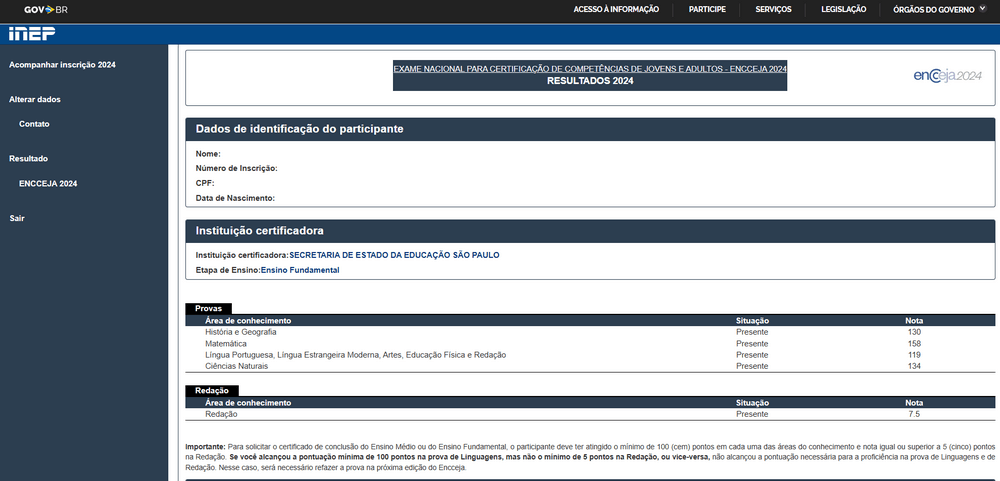
If all subjects are above 100 — Parabéns, you did it! Now you just need to wait for the certificate.
If some subjects are above 100 and others are not, you can receive a partial certificate. Next year you only need to register for the subjects you didn’t pass.
Certificate
The certificate doesn’t appear immediately after the results. The exam itself is organized by INEP, but they don’t issue certificates. They send the results to institutions responsible for certification. Usually this is either the State Department of Education, or a federal university in your state. The specific institution is shown on your participant page.
In some states (for example São Paulo) you can download the certificate online very easily once it becomes available. In other states you may need to visit the institution in person.
Good luck if you’re preparing for Encceja — it’s definitely doable.
This post was about Ensino Fundamental, which I took last year. I’ve already taken Ensino Médio this year too — I just haven’t written about that exam yet. I’ll share that experience soon.
Tchau!